Appendicitis
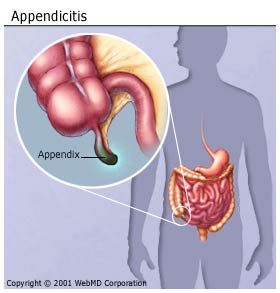
Appendicitis is an inflammation of the
appendix,
a 3 1/2-inch-long tube of tissue that extends from the large intestine.
No one is absolutely certain what the function of the appendix is. One
thing we do know: We can live without it, without apparent consequences.
Appendicitis is a medical emergency that requires prompt surgery
to remove the appendix. Left untreated, an inflamed appendix will
eventually burst, or perforate, spilling infectious materials into the
abdominal cavity. This can lead to
peritonitis,
a serious inflammation of the abdominal cavity's lining (the
peritoneum) that can be fatal unless it is treated quickly with strong
antibiotics.
Sometimes a pus-filled
abscess
(infection that is walled off from the rest of the body) forms outside
the inflamed appendix. Scar tissue then "walls off" the appendix from
the rest of the
abdomen,
preventing infection from spreading. An abscessed appendix is a less
urgent situation, but unfortunately, it can't be identified without
surgery. For this reason, all cases of appendicitis are treated as
emergencies, requiring surgery.
In the U.S., one in 15 people will get appendicitis. Although it
can strike at any age, appendicitis is rare under age 2 and most common
between ages 10 and 30.
What Causes Appendicitis?
Appendicitis occurs when the appendix becomes blocked, often by stool, a foreign body, or
cancer. Blockage may also occur from infection, since the appendix swells in response to any infection in the body.
What Are the Symptoms of Appendicitis?
The classic symptoms of appendicitis include:
- Dull pain near the navel or the upper abdomen that becomes sharp as it moves to the lower right abdomen. This is usually the first sign.
- Loss of appetite
- Nausea and/or vomiting soon after abdominal pain begins
- Abdominal swelling
- Fever of 99-102 degrees Fahrenheit
- Inability to pass gas
Almost half the time, other symptoms of appendicitis appear, including:
- Dull or sharp pain anywhere in the upper or lower abdomen, back, or rectum
- Painful urination
- Vomiting that precedes the abdominal pain
- Severe cramps
- Constipation or diarrhea with gas
If you have any of the mentioned symptoms, seek medical attention
immediately since timely diagnosis and treatment is very important. Do
not eat, drink, or use any pain remedies, antacids,
laxatives, or heating pads, which can cause an inflamed appendix to rupture.
How Is Appendicitis Diagnosed?
Diagnosing appendicitis can be tricky. Symptoms of appendicitis
are frequently vague or extremely similar to other ailments, including
gallbladder problems,
bladder or
urinary tract infection,
Crohn's disease,
gastritis, intestinal infection, and ovary problems.
The following tests are usually used to make the diagnosis.
- Abdominal exam to detect inflammation
- Urine test to rule out a urinary tract infection
- Rectal exam
- Blood test to see if your body is fighting infection
- CT scans and/or ultrasound
How Is Appendicitis Treated?
Surgery to remove the appendix, which is called an appendectomy, is the standard treatment for appendicitis.
If appendicitis is even suspected, doctors tend to err on the
side of safety and quickly remove the appendix to avoid its rupture. If
the appendix has formed an abscess, you may have two procedures: one to
drain the abscess of pus and fluid, and a later one to remove the
appendix.
Appendectomy: What to Expect
Antibiotics are given before an appendectomy to fight possible
peritonitis. General anesthesia is usually given, and the appendix is
removed through a 4-inch incision or by laparoscopy. If you have
peritonitis, the abdomen is also irrigated and drained of pus.
Within 12 hours of surgery you may get up and move around. You
can usually return to normal activities in two to three weeks. If
surgery is done with a laparoscope (a thin telescope-like instrument for
viewing inside the abdomen), the incision is smaller and recovery is
faster.
After an appendectomy, call your doctor if you have:
- Uncontrolled vomiting
- Increased pain in your abdomen
- Dizziness/feelings of faintness
- Blood in your vomit or urine
- Increased pain and redness in your incision
- Fever
- Pus in the wound
Can Appendicitis Be Prevented?
There is no way to prevent appendicitis. However, appendicitis is
less common in people who eat foods high in fiber, such as fresh fruits
and vegetables.
http://www.webmd.com/digestive-disorders/digestive-diseases-appendicitis